Introduction: Beyond the Specs Sheet
Sourcing monitors from China can feel like navigating a minefield. With thousands of factories claiming to be “professional manufacturers,” how do you distinguish between a true OEM/ODM partner and a trading company reselling generic stock?
For B2B buyers—whether you are a distributor in Latin America, an Internet Cafe owner in Southeast Asia, or an Amazon private-label seller—the goal isn’t just to buy hardware; it’s to secure a competitive advantage. In 2025, two categories dominate the market growth: the 27″ 2K 144Hz Curved Gaming Monitor and the 15.6″ Portable Dual-Screen Extender.
This guide breaks down the technical nuances of these two “cash-cow” products and provides a checklist to ensure your next bulk order maximizes ROI while minimizing supply chain risks.
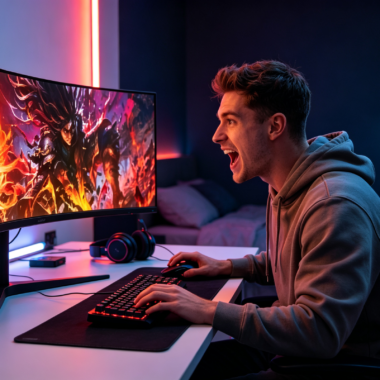
1. The 27″ 2K 144Hz Curve: Why It’s the King of Entry-Level Esports
The 27-inch form factor has hit the sweet spot for pixel density and price. But not all 27″ monitors are created equal. To capture the mass market, you need to understand why specific specs matter to your end-users.
Why VA Panel & 1800R Curvature?
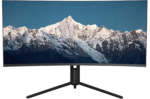
While TN panels offer speed, they lack color depth. Our ZW-MC273 model utilizes a VA (Vertical Alignment) panel with a 1800R curvature.
- The Business Case: The 4000:1 native contrast ratio delivers deeper blacks and more immersive visuals than standard IPS panels at this price point. For Internet Cafes, the curvature reduces eye strain during marathon gaming sessions, encouraging longer playtime.
- The Spec Check: Ensure your supplier uses true 1800R curvature. Cheaper 3000R or 4000R curves feel flat and fail to provide the “wrap-around” effect that gamers crave.
144Hz + 1ms: The Performance Baseline
If you are targeting the FPS (First-Person Shooter) and MOBA markets, 144Hz is no longer a luxury—it’s the baseline.
- The Advantage: Paired with a 1ms response time, this eliminates motion blur. When a buyer sees “144Hz,” they expect smooth crosshair tracking in games like Valorantor CS:GO.
- The Hidden Value: Look for Dual HDMI 2.0 and Dual DP 1.4 ports. This allows Internet Cafe owners to switch between consoles and PCs without swapping cables—a small detail that adds significant value in a commercial setting.
Low Power Consumption: The Untapped Selling Point
Most factories ignore power specs. However, for bulk buyers, 39W power consumption and 0.5W standby mode are critical.
- The ROI: An Internet Cafe with 100 machines running 10 hours a day saves approximately 20% on electricity compared to older 50W+ models. This is a powerful argument to make when selling to commercial clients.
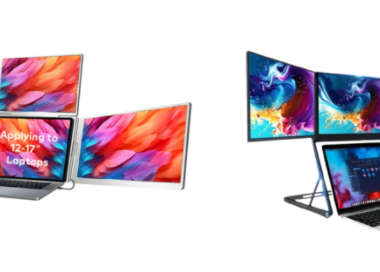
2. The 15.6″ Portable Dual-Screen: Tapping into the “Digital Nomad” Boom
The pandemic normalized remote work, but 2025 is defined by the “Digital Nomad.” The demand for multi-tasking tools has exploded, making the 15.6″ Portable Dual Monitor one of the fastest-growing segments in consumer electronics.
Productivity vs. Entertainment
Unlike single portable screens, the dual-screen extender targets high-intent users:
- Financial Traders: They require multiple windows for charts, news feeds, and trading terminals. The ability to rotate 90° for vertical tickers is a premium feature.
- Software Developers: Coding on a laptop while referencing documentation on a second screen drastically improves efficiency.
- Sales Professionals: Perfect for on-the-go presentations where screen real estate matters.
Connectivity: One Cable is King
When sourcing these units, the quality of the Type-C connection is paramount.
- The Requirement: Ensure the device supports PD (Power Delivery) charging. This means the monitor can draw power from the laptop or charge the laptop while displaying video—all through a single cable.
- Compatibility: Don’t forget Mini-HDMI. This ensures compatibility with Nintendo Switch, DSLRs, and legacy laptops, broadening your potential customer base beyond just office workers.
Build Quality for Logistics
Portable monitors are fragile. As a buyer, you must ask about packaging. Our units are designed to withstand long-haul shipping, but many competitors use thin plastic shells. Aluminum-magnesium alloy frames not only look premium but also dissipate heat better, preventing screen damage during transit—a key concern for Amazon FBA sellers.
3. The OEM/ODM Checklist: 3 Questions to Ask Your Supplier
To move from a “buyer” to a “brand owner,” you need a factory, not just a vendor. Here are three technical questions to separate the pros from the amateurs:
- Color Calibration (Delta E): Most factories give you a “default” profile. If you want to target the semi-pro design market, ask if the factory can provide a calibration report with Delta E < 2. This ensures color accuracy right out of the box.
- Certification Transparency: CE and FCC are standard, but do they have the test reports? Can they provide RoHS compliance certificates? Without these, your containers might get stuck at customs, costing you thousands in demurrage fees.
- Customization Lead Time: How long does it take to print a logo (Silk Screen vs. Laser Etching)? How long for a custom gift box? A reliable partner should offer 5-7 days for samples and 25-30 days for mass production once the artwork is confirmed.
4. Which Model Fits Your Market Strategy?
| Target Market | Recommended Product | Key Customization |
|---|---|---|
| Southeast Asia / Middle East Internet Cafes | 27″ 2K 144Hz Curved | Anti-theft Kensington Lock, Low Power Consumption, RGB Backlights |
| North America / Europe E-commerce | 15.6″ Portable Dual Screen | Premium Retail Box, Multi-language Manuals, Aluminum Alloy Body |
| Corporate / Office Procurement | 24″ Frameless IPS | Low Blue Light Mode, VESA Mount Compatibility, Energy Star Rating |
Conclusion: Build Your Brand with Confidence
Sourcing monitors is not just about finding the lowest price; it’s about finding a partner who understands your market’s technical requirements and logistical challenges.
The 27″ 144Hz Curved Monitor remains the undisputed volume leader for gaming channels, while the 15.6″ Dual Portable Screen offers high margins in the productivity niche. By focusing on the details—power consumption, connectivity, and build quality—you protect your investment and build a reputable brand.
Ready to take the next step?
Stop guessing and start building. Contact our engineering team today to request a free sample or download our 2025 Full Catalog to explore private mold options.
👉 [zhiwei05@zwdisp.com | 👉 [https://www.zwdisp.com/products/]
FAQ (Schema Markup Recommended)
Q: What is the Minimum Order Quantity (MOQ) for custom logo monitors?
A: For our standard hot-selling models (like the ZW-MC273), the MOQ is typically 100-300 units for logo printing. For fully customized housing or new tooling, the MOQ usually starts at 1,000 units.
Q: Do you support drop-shipping for portable monitors?
A: We specialize in B2B wholesale and OEM manufacturing. While we don’t operate as a drop-shipping agent, we can ship directly to your FBA warehouse or 3PL provider with proper labeling (FNSKU).
Q: What warranty do you offer for bulk orders?
A: We provide a standard 1-year warranty covering non-human-induced defects. For large volume orders (500pcs+), we offer a 0.3%-0.5% spare parts allowance to help you handle after-sales locally without the need for returns.